Phoenix Knights
By on 26 May 26 09:40


28 views
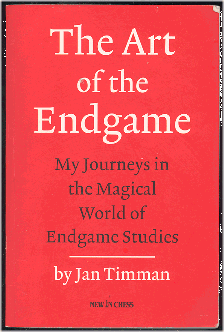
Back to this book by Jan Timman and we look at Phoenix Knights.
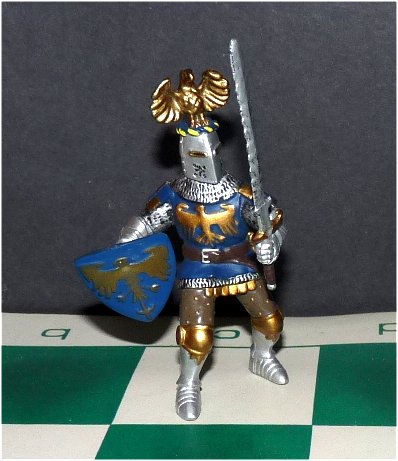
A Phoenix Knight is a pawn that has been under promoted to a Knight.
and prior to that happening a Knight has to be sacrificed to clear the way
for the new Knight - which has risen from the ashes of the sacrificed Knight .
Easier to show a Phoenix Knight than explain one. I can use an RHP game.
Mr Ch - Luck RHP 2008 A basic example of a Phoenix Knight
The end of a study by A. A. Troitsky from Jan Timman’s book (White to play and win)
There is a Phoenix Knight opening trap which, I am disappointed to say, none
of you have lot have fallen into.(yet). C’mon where is your spirit of adventure.
We end with a RHP Phoenix Knight mate from Intedev - m3575 RHP 2007
21...e2 22.Rxf2 The Knight is gone...only to rise again. 22...e1=N mate.

No theme clues this week. A mixture of White to play and wins.
The Bishop and the h4 Rook are undefended. One of the Queen’s main
strengths is to carry out a double attack, a Queen Fork, can you spot it.
We will play out the solution to this one.


Let us now go topical with a Carlsen game that finished yesterday.
A. Firouzja - M. Carlsen, Norway Chess, 25th May .2026 (Black to play)
Carlsen thought he could not play 33...Nxe3 due to 34.Qg6+ Kg8 35. Ra7
and after 35...Qxa7 36.Qxe8+ and 37.Qxe3 so instead of 33...Nxe3 he
played 33...Kg8 and went onto lose. but he could have played 35...Nd1!
And if 36.Rxd7 Rxe1 is checkmate.
After 35...Nd1 the general consensus is that Magnus could have held a draw.
After 33...Kg8 34 e4 White was two pawns up and Black resigned on move 38.
This time you have not left me down with dozens of RHP games mating White this way.
Roadstar - catfoodtim RHP 2012 (Black has just played 32...Nd1)
White saved the attacked b2 pawn 33. b4 Re1 mate.
Gary Gibson - FiilR RHP 2010 (Black has just played 36...Nd1)
White was not going to swap a Bishop for a Knight. 37. Bd4 Re1 mate.
The thread accompanying this blog is Thread 205530